


First and foremost, automatic parking refers to the system's ability to park the car without manual intervention, which can be seen as a godsend for novice drivers. Why is such a convenient technology not widely embraced? Here are the reasons:
While automatic parking can free the driver's hands, it has a significant drawback: its accuracy in identifying parking spaces is not optimal. The system mainly relies on several sensing radars to gauge the distance from obstacles. If an object is hanging mid-air or is too low, the radar might not detect it, leading to potential collisions.
The speed control accuracy of automatic parking is also lacking. Even if the sensing radar can accurately detect an obstacle and react promptly, it cannot precisely control the car's speed in real-world scenarios. This lack of control can result in the car inadvertently colliding with the obstacle due to inertia.
Activating the automatic parking feature can be cumbersome. The car must be in 'Drive' mode, and the driver must simultaneously control the vehicle and keep an eye on the central console display to assist the system in identifying the parking space.
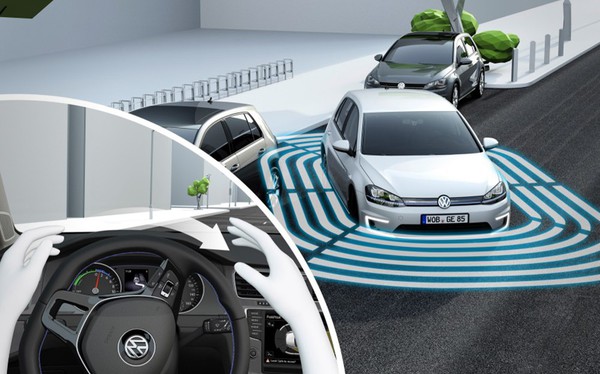
Differences Between APA and AVP Automatic Parking:
Degree of Intelligence:
APA is the first generation of automatic parking technology. It requires the driver's in-car assistance to complete the parking. AVP, as the fourth generation, allows the driver to remotely operate the car to find a parking spot and park within 500 meters outside the vehicle. It can also control the car to leave its parking space and drive to a designated location when needed.
Level of Autonomous Driving:
APA's autonomous driving level is at level 2, while AVP's is at level 4.
Sensor Layout:
Compared to APA, AVP automatic parking is equipped with four fisheye cameras, achieving a 360° surround view. It can also be controlled using the car's onboard Bluetooth.



