


Volkswagen Says Hydrogen Tanks Take Up Too Much Space:
From an interview with Autobild.es earlier this month at the 2023 CES in Las Vegas, the publication asked Volkswagen Passenger Cars CEO Thomas Schäfer about his stand towards hydrogen cars.
“Hydrogen is not for us,” he said. “No. Hydrogen is pure physics and it’s expensive. It’s not competitive, especially not for passenger cars, whose tanks take up space in the cabin. Maybe for commercial vehicles, but not in the passenger car. So, I don’t see this happening in this decade. Not at Volkswagen.”
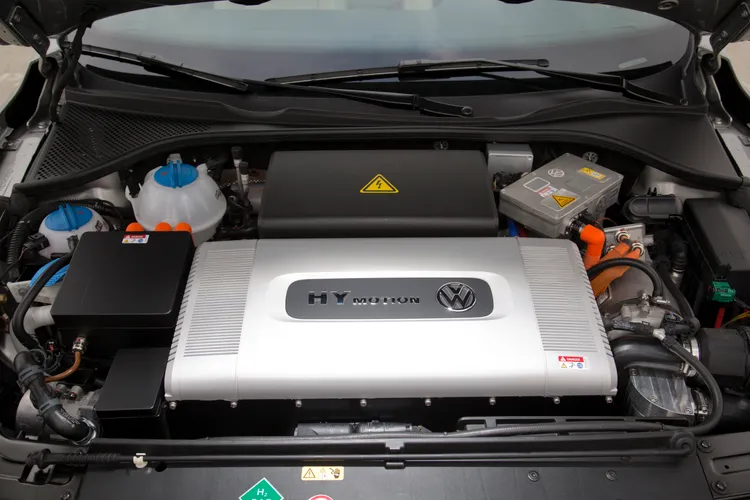
It wasn’t too long ago when Volkswagen dipped its toes into the world of hydrogen fuel cell mobility. In 2014, the German automaker unveiled two HyMotion vehicles — the Golf Estate HyMotion and Passat HyMotion. Both models are hydrogen fuel cell electric vehicles (FCEVs), in which a more popular example would be the Toyota Mirai. Being FCEVs, the two HyMotion cars utilize a 134-horsepower electric motor and a lithium-ion battery pack that’s charged by taking advantage of the chemical process that bonds hydrogen with oxygen, thus water vapor becomes its direct tailpipe emissions. The hydrogen was then stored in a specially-developed carbon fiber tank that was placed underneath the cargo floor. Hydrogen tanks take up more space than a conventional petroleum or diesel tank, which is one of the major reasons why Volkswagen argues that it doesn’t make sense to use FCEV technology on passenger cars.
On the other hand, its sister brand Audi is a stronger supporter of hydrogen vehicles. The German luxury automaker developed more FCEV prototypes than its parent company, one of which includes the A7 h-tron, but that support for hydrogen was short-lived. In 2021, Audi joined a long list of automakers that see no future in hydrogen technology.
Meanwhile, Toyota and BMW have been very strong in their efforts in pursuing hydrogen mobility. In fact, the two brands unveiled a number of prototypes and limited-production models that run on hydrogen. Toyota recently showcased a Corolla Cross that uses the same hydrogen combustion technology that powers a prototype GR Yaris and even an AE86 that also combusts hydrogen.
On the German side of the two brands, BMW recently put into limited production an X5 that uses hydrogen fuel cell technology. Unlike Volkswagen Group, BMW continues to invest in hydrogen technology as the company doesn’t just see EVs as the future of clean mobility.
With automakers mostly committed to EVs, will hydrogen ever gain traction in the automotive industry? That could change if Tesla's CEO Elon Musk suddenly reconsiders its stance against hydrogen.



