


The BYD YangWang U8 is equipped with the E4W (Easy 4 Wheels) technology platform, which is centered around four-wheel edge motors. This platform not only brings the "tank turn" feature but also represents a significant innovation in the driving system for passenger vehicles.
Let's first discuss the E4W technology platform. It is currently one of the most comprehensive and advanced electrification platforms in China, with excellent compatibility and advanced electrical technology. One of the major highlights of this platform is the inclusion of an 800V SiC (Silicon Carbide) electronic control system, which will be standard across the platform's future products. Compared to existing platforms, the electronic control system offers a maximum efficiency improvement of up to 99.5%, a 50% increase in current output capability, a 100% increase in power density, and a 3% improvement in operational efficiency. These enhancements are crucial for large and mid-size SUVs like the YangWang U8.

Another highlight of the E4W technology platform is its support for both pure electric and plug-in hybrid powertrains. From the official chassis images of the YangWang U8, we can clearly see a translucent four-cylinder engine, indicating the availability of a hybrid version. Moreover, the E4W technology platform is built around a powertrain system with four independent motors, the famous four-wheel edge motors featured in the BYD YangWang U8. All future products under the E4W platform, such as the U9 supercar, will come standard with these four-wheel edge motors. This powertrain system represents a significant innovation in the driving form of passenger vehicles and greatly enhances the driving experience. Now, let's focus on the technological highlights brought by the four-wheel edge motors in the BYD YangWang U8, including the much-anticipated "tank turn."
The four-wheel edge motors not only enable the "tank turn" feature but also support capabilities such as continuing to drive with a flat tire and super water wading with emergency floating.
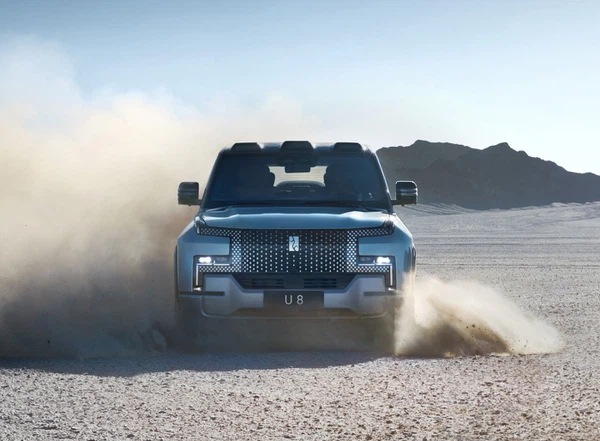
Speaking of the "tank turn" feature, it is not a new technology. Tanks can achieve it, and even special vehicles like tracked excavators and loaders commonly seen on construction sites have already implemented it. The greatest advantage of the "tank turn" is the ability to significantly reduce the turning radius, allowing vehicles to perform turning maneuvers in relatively tight spaces.
The implementation of the "tank turn" feature is relatively simple. Taking tanks as an example, during a turn, one side's tracks rotate forward while the other side's tracks rotate backward. The working principle of the "tank turn" in the BYD YangWang U8 is exactly the same as that of tank tracks. However, implementing this technology on wheeled vehicles is not as straightforward as on tracked vehicles.

In traditional tracked vehicles, controlling the speed difference between the left and right tracks is sufficient for a tank turn. However, achieving control of wheel speed differences between four wheels on a vehicle is much more challenging. This is the reason why the "tank turn" technology has not been widely adopted in passenger vehicles, and the complexity goes beyond cost considerations.
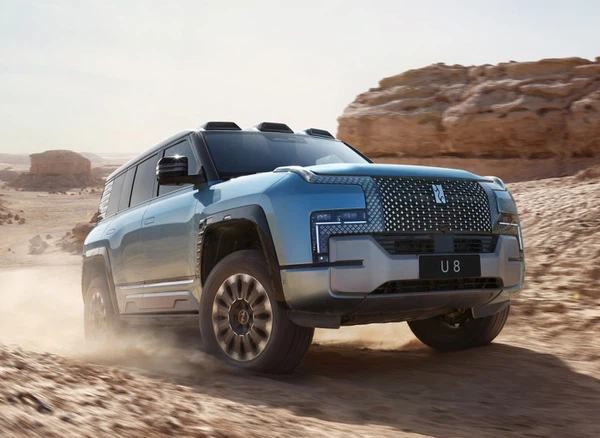
So how does the BYD YangWang U8 achieve the perfect "tank turn" demonstrated in the previous videos? First and foremost, the motors need to provide sufficient power. Each of the YangWang U8's four-wheel edge motors can deliver a maximum output power of 220-240 kW, with peak torque ranging from 320-420 N·m. With abundant torque, the wheel edge motors can surpass the limit of tire friction and set the wheels in motion, thus naturally achieving the "tank turn."
Of course, the "tank turn" technology is not as simple as it may appear in videos. The most crucial aspect is achieving this functionality under different friction conditions. BYD had already achieved low-friction "tank turn" ten years ago, but achieving it under high-friction conditions is much more challenging for passenger vehicles. This is because traditional mechanical structures become overly complex and bulky when attempting to implement this feature. However, the four-wheel edge motors perfectly solve this problem. Once the four-wheel edge motors are in place, the system needs to be matched from perception, control, and execution perspectives. This includes integrating intelligent driving sensor data from cameras, lidars, millimeter-wave radars, etc., to provide a perceptual data foundation for subsequent decision-making and execution. In the control phase, a highly coordinated electronic and electrical architecture with a central computing platform and domain control architecture is required. This involves real-time communication of perceptual information and control strategies through high-bandwidth, low-latency, and high-security onboard Ethernet. Through the highly coordinated interaction between controllers and sensors, precise and diversified control of the four motors can be achieved. Therefore, the "tank turn" feature of the BYD YangWang U8 is not difficult to implement, but it is challenging to do it well. However, once successful, it brings more than just the "tank turn" capability.
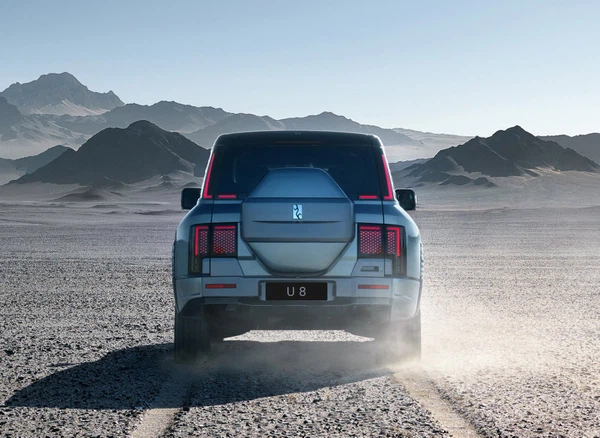
During the presentation, BYD also unveiled some additional features provided by the YangWang U8's four-wheel edge motors. For example, the ability to continue driving with a flat tire allows the four-wheel edge motors to continuously adjust the power output of the remaining three wheels, providing enhanced safety. Additionally, the YangWang U8 supports super water wading with emergency floating. In extreme situations like encountering flooded areas, each wheel edge motor can utilize the principle of differential pressure on a single tire to propel the vehicle forward, helping it move away from the affected area. This functionality is also highly practical.



