


1 Introduction
Henry Ford (July 30, 1863 – April 8, 1947) was an American automotive engineer and entrepreneur, founder of the Ford Motor Company. He was also the first person in the world to mass-produce cars using an assembly line. His method of production transformed the car into a product for the masses. This not only revolutionized industrial production methods but also had a profound impact on modern society and culture. In the book "The 100: A Ranking of the Most Influential Persons in History" by Michael H. Hart, Henry Ford was the only entrepreneur to make the list.
2 Personal Experience Childhood Stories
At school, Henry Ford often daydreamed. One day, he and a friend disassembled a watch. The teacher, furious, told them to fix it after school before they could go home. The teacher was unaware of young Ford's genius. In just ten minutes, this mechanical prodigy repaired the watch and was on his way home.
Ford was always curious about how things worked. Once, he plugged the spout of a teapot and then placed it on a stove. Curious, he waited to see what would happen. As expected, the boiling water turned into steam, and with nowhere to escape, the teapot exploded, shattering a mirror and a window. The young inventor was also severely burned.
Years later, Ford's curiosity and hands-on skills paid off. He dreamed of creating a horseless carriage. After building one, the transportation industry was forever changed.
Early Experience
Henry Ford was born in Springwells Township, Wayne County, MI., which is now part of Dearborn, MI. Ford's parents, William and Mary Ford, were immigrants from Ireland. He was born on their farm and was the eldest of six children. He showed an interest in machinery from a young age. By 12, he had set up his mechanical workshop, and by 15, he had built his internal combustion engine.
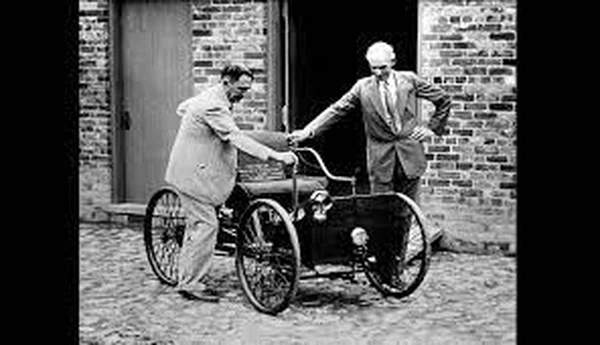
In 1879, he left home to become a mechanical apprentice in Detroit. After completing his apprenticeship, he joined Westinghouse Electric. He married in 1888. By 1891, Ford had become an engineer at Edison Illuminating Company. By 1893, after being promoted to chief engineer, he had ample time and resources to continue his personal research into the internal combustion engine. In 1896, he built his first car, which he named the "Quadricycle."
Company Establishment
He and some other inventors left Edison to form the Detroit Automobile Company. However, this company quickly went bankrupt because Ford was more interested in researching new vehicles than selling them. He decided to prove the superiority of his vehicles by racing them against others. His second company, Henry Ford Company, primarily produced his race cars. On October 10, 1901, he even won a race driving his car. However, soon after, his financiers forced him out, and the company was renamed Cadillac.
With 11 other investors and $28,000 in capital, Ford established the Ford Motor Company in 1903. He designed a car that covered a mile in just 39.4 seconds. A famous racer of the time named this car the Ford 999 and toured with it around the U.S., making Ford a household name.
In 1908, the Ford Company introduced the Model T. From 1909 to 1913, the Model T won many races. Ford withdrew from racing in 1913 due to his dissatisfaction with the racing rules. By that time, the Model T was already very popular. That same year, Ford introduced the assembly line to his factory, greatly increasing production. By 1918, half of all cars in America were Model Ts. Ford was very protective of the Model T design (Ford once said, "Any customer can have a car painted any color he wants so long as it's black"). This design was maintained until 1927. By then, Ford had produced 15 million Model Ts. This remained a world record for the next 45 years.
Connection with the Nazis Evidence from September 1930 in Germany suggests that Henry Ford may have financially supported Adolf Hitler in his early political career. Some Germans claim to have received donations from Ford to Hitler in the 1920s. However, a 1933 US Congressional investigation could not confirm such donations.
Before the outbreak of World War II, the Ford Motor Company was involved in Germany's military buildup. For instance, in 1938, the company opened an assembly plant in Berlin to supply trucks for the German army. That year, Ford was awarded the Grand Cross of the German Eagle, the highest Nazi medal for foreigners. Ford was the first American to receive this honor, attributed to his pioneering work in making cars a mass product. Hitler personally sent a congratulatory letter.
Ford Foundation In 1936, in Michigan, Henry Ford and his son Edsel established the Ford Foundation. Initially, it was a regional charity aimed at promoting human welfare broadly. The foundation grew rapidly, and by 1950, it had become a national and international organization.
Final Days By the end of the war, Ford's health had significantly deteriorated. On September 21, 1945, he stepped down in favor of his grandson, Henry Ford II. On April 7, 1947, he passed away at his residence in Dearborn at the age of 83, buried in the Ford Cemetery in Detroit.

3 Biography
Born on July 30, 1863, in Greenfield, Michigan. His father was an Irish immigrant, and Henry was the eldest of six siblings.
Henry taught himself to become a steam engine technician. In 1887, he joined the Edison Electric Light Company in Detroit as a technician and later became the chief engineer.
He dedicated himself to car design and, in 1896, produced a two-cylinder, air-cooled, four-horsepower car. In 1898, he resigned. In 1899, he founded the Detroit Automobile Company, but after producing only 25 cars, it went bankrupt in January 1901.
On June 16, 1903, Ford once again established an automobile company and continued to serve as general manager. That year, the company produced its first Ford car. In 1908, Ford produced the Model T. This popular car sold well in Europe.
In 1911, the first automobile assembly plant was established in Kansas City, Missouri.
In 1908, he produced the world's first Model T, which changed the way Americans lived.
In 1913, Ford established the world's first car assembly line. This assembly line method, later known as the "Ford System," was extensively promoted worldwide. This efficient method of production organization was based on standardization.
In 1914, he became the first to pay workers an 8-hour wage of $5, changing the way American workers worked.
In 1915, US President Wilson met Ford and praised the Ford Motor Company.
In 1919, Henry bought out the shares of other shareholders, monopolizing the company. Using funds from Citibank, he expanded production, making it the world's largest automobile company in the 20th century. Ford himself was known as the "King of Cars," and his family became one of America's major financial powerhouses.
In 1921, US President Harding met Ford and lauded, "You have created the most remarkable company for America."
In 1927, the company stopped producing the Model T and started producing the new Model A. In 1932, it began to produce the V-8 model. Today, the company has diversified, producing and selling cars (Ford, Mercury, Lincoln, Continental), trucks, tractors, and related parts and accessories. They also develop and manufacture consumer electronics and space industry products (including communication and weather satellites).
In 1929, US President Hoover attended the inauguration of the Ford Museum.
In 1936, Henry Ford and his son Edsel founded the Ford Foundation in Michigan. Initially a regional charity, its purpose was to promote human welfare widely. By 1950, it had become a national and international organization.
In 1943, after the death of his only son Edsel, he handed over much of the company's management to his grandson, Henry Ford II.
In 1946, the "Golden 50 Years of Automobiles" awarded him an honor for his contribution to the automobile industry; The New York Times commented: "Ford is not only the founder of the Ford Motor Company but also propelled the entire automotive industry's development."
On April 3, 1947, Henry Ford passed away. On the day of his funeral, all car production lines in the US stopped for a minute to honor the "Copernicus of the automotive world."
In 1999, Fortune magazine named Ford the "Greatest Entrepreneur of the 20th Century" to honor his and the Ford Motor Company's contributions to human development.
In 2005, Forbes magazine listed Henry Ford as the most influential entrepreneur in history. Book title: "My Life and Work".

4. Management Philosophy
Holding the Purse Strings
In 1896, Henry Ford drove Detroit's first "gasoline horseless carriage" onto the streets; in August 1899, at the age of 37, he resigned from the electric company and devoted all his energy to the automobile industry. His wife staunchly supported him. Controlling the company's finances was the first step for this technical expert to realize his dream.
Initially, he served as the chief engineer for the Detroit Automobile Company (predecessor of Cadillac). After three years of workshop-style production, he resigned again, determined "never to be under someone else's command again." In 1903, the Ford Motor Company was established with a capital of $100,000, and his initial stake was 25.5%.
"Despite previous lessons, I still wanted to develop a company where my own stake was less than the controlling stake," Henry Ford later recalled. "However, I soon realized that I had to have a controlling interest." When production reached 100 cars a day, some shareholders felt uneasy, trying to stop Henry Ford from managing the company. His response was, "I've long hoped to produce 1,000 a day."
By 1906, using the money he earned, Henry Ford acquired 51% of the shares and soon after increased his stake to 58.5%. By 1919, his son Edsel bought the remaining 41.5% of shares for $75 million.
"For a factory to truly benefit economically, it must go all out to produce one product," Henry Ford believed. "Financial strategy is determined by my sales strategy, and I believe that selling at a small profit in large quantities is much better than selling at a large profit in small quantities." This implied unprecedented risks. If the Ford Company at that time had been constrained by investment funds, it would have been difficult to take the "amazing leap" after steady profits and venture into the unprecedented "mass consumer goods market"—meaning simple varieties, large-scale production, and a low-priced sales network.
The Ford Company grew magically fast. Since history is written by victors, since mature markets once existed only in Henry Ford's mind, and since he won this gamble, he was right.
The factory owner's ability to control finances was once challenged by Wall Street. In late 1920, the auto manufacturing industry, which had inflated during the war, faced a recession, and Wall Street predicted that the Ford Company would need a lot of working capital. The Ford family had previously bought all the shares of the company, and in the first few months of 1921, they had to pay $58 million—at a time when the Ford Company's bank account had only $20 million.
Considering Henry Ford's long-standing prejudice against financial capital and borrowing, Wall Street was elated. One solution was to borrow money. In exchange for a massive loan, the bank would send a representative to serve as the chief financial officer of the Ford Company. Henry Ford launched a battle to tap the potential within the enterprise. He appointed his son as the company's CFO, cleared redundancy from the war years, reclaimed money from abroad, sold liberty bonds, and sold by-products.
In late January 1921, 10,000 key employees (foremen, junior foremen, and assistant foremen) gathered at the core factory to start work. The indirect cost of each car was reduced from $146 to $93 (with a daily production of over 4,000 units); by improving transportation, the production cycle was shortened from 20 days to 14 days, freeing up $28 million. The end result was that after the Ford Company repaid its debts, it still had $27.3 million in cash.
"Borrowing money to expand production is one thing, borrowing money to make up for poor management and waste is another," reflected the industrial capitalist after the counterattack. "Bankers effectively control the general entrepreneur by controlling his credit. Bankers are too comfortable."
Mastering Core Technology and Materials
A Ford car consists of approximately 5,000 parts. Mastery over the core materials, technology, and key components of production is a prerequisite for large-scale production. Initially, Ford assembled entire cars in one factory, but as they started manufacturing their own parts, they began to departmentalize, with each department responsible for one task. With the fine division of labor, Ford reduced external component purchases and manufactured them in external factories. Highly standardized and highly specialized industries were no longer concentrated in one large factory.
Steel is the cornerstone of materials used in the auto industry. In 1905, during a car race, Henry Ford discovered that the steel of a French race car was excellent - light and resilient. After research, they learned that this type of French steel contained vanadium. No steel mills in the US could produce it, so they found a Brit who knew how to produce it and a small steel mill for blast furnace trials. From then on, they began using 20 different types of steel to make various parts.
Car production requires a lot of coal. This coal is transported directly from Ford Company's coal mines via Detroit, Toledo, and the Ford-controlled Elton railway to the Highland Park factory and the 665-acre Rouge River factory. Part of it is used in coke ovens, and its byproduct—coal gas—is used for heat treatment. Originally, they had to pay for coal gas.
Not being "dependent on external sources" for materials and components that could affect production stability ensured that Ford's production was unaffected by weather or war. On the contrary, during wartime, they manufactured submarines for the navy, tanks for the army, and provided 5,000 tractors for British farms. The acclaimed Model T was the first Ford car to use its engine and, in Henry Ford's eyes, was the "final car model."
Title-less Management
"A tree is laden with beautiful round berries... responsibilities are strictly limited within the circumference of his berry," the farmer's son described "office politics". "A group of people come together to work, not to write letters to each other; for people to work together, they don't need to love each other," he believes. "A lot of labor unrest originates from junior managers exercising power unjustly."
Internally, Ford Company advocates maximum "title-less management": "There are no specific responsibilities attached to any position, no series of hierarchical powers, and almost no titles, no meetings... no red tape."
"No one will boast about being the chairman of a bankrupt bank. In general, enterprises are hard to master, so you can't give the helmsman kind of pride." Experience shows that the difficulty isn't finding someone to promote, but who wants to be promoted. Because not many people hope to get more money while also hoping to take on more responsibilities and work.
This is normal. This is better than dividing responsibilities based on titles and viewing promotions as job goals. "We don't have any pre-prepared positions, our best people always find positions. This is easy to achieve, because there's always work," Henry Ford said. "When you're thinking about doing the job well, rather than finding a suitable title for someone who hopes to be promoted, then there's no difficulty in promoting."

5. High Wages + Benefits
"As a leader, the employer's goal should be to give workers higher wages than any other company in the industry," Henry Ford's wage concept embodies "enlightened self-interest": workers receive a minimum wage of $6 per day; working hours are first shortened from 9 hours to 8 hours. He didn't advocate hiring "dual-income families" because it's "harming children" for mothers to work.
"High wages" also have another meaning. After analysis, out of 7,882 tasks, 4,034 didn't require full physical capabilities. This became the theoretical basis for Ford factories hiring disabled individuals. Tens of thousands of disabled people received regular wages equally.
In addition to wages, there were benefits. The criteria for benefits were: married men who support family life, and "thrifty" single men and women who support relatives.
High wages combined with benefits help achieve low costs. Workers have deep feelings for the factory, and efficiency-enhancing, cost-saving creative methods emerge endlessly. Good suggestions often come from diligent workers. Using an overhead conveyor to transport cast iron from the foundry to the machine shop saved the transport department 70 people. It is estimated that the benefits Ford gained from savings exceeded $40 million: if every part saves a penny, the total annual amount can reach millions of dollars. $600,000 a year can be obtained from cleaning trash; using a special screw can save $500,000 a year...
"Wages solve nine-tenths of mental problems," Henry Ford concluded. "Just as we don't know how high wages should be, we also don't know how low prices should be." The beneficiaries of the benefits even included customers. Ford Company's profits have remained high due to fast capital turnover. One year, the profit was much higher than expected, so the company voluntarily returned $50 to every car owner.
Henry Ford once said: The secret of success is to put oneself in someone else's shoes, then consider things from their perspective. Service is such a spirit, looking at the world from the guest's point of view.

6. Process Decomposition and Optimization
On October 1, 1908, Ford introduced the Model T. With this "Car of the Century," factory production management stabilized daily. Each foreman recorded the efficiency of his department every day. Supervisors had a comprehensive form, and if something was wrong in a department, the production form would show it immediately.
For the hassle of car manufacturing, "process decomposition and optimization" was resolutely and thoroughly advanced, and the results were astonishing. Take piston rod assembly as an example: using the old method, 28 people assembled 175 a day—3 minutes and 5 seconds each. After the foreman analyzed the motion with a stopwatch, he found that half the time was spent moving around, with each person making six movements. So, he revamped the process, divided workers into three groups—no more moving around, installed pulleys on stools—now 7 people could assemble 2,600 a day.
Almost every week, the Ford Company made some improvements to machinery or working procedures. When the production scale was small, the factory required 17 dirty and tired people to clean the burrs of gears; with specialized machines, four people could easily do the work of dozens. 37 people were once needed to straighten camshafts in ovens. After using a new type of furnace, even with increased production, only eight people were required...
The complete decomposition and optimization of the production process hinted at the most disruptive force in production history. Based on this, Henry Ford created the unprecedented assembly line.



